Cozy Mystery Puzzles for Families: A Screen-Free Way to Think Together
Try a tiny whodunit, reveal the answer, and find comfortable ways for children, adults, and older readers to solve together.
Shamal Iroshan
October 26, 2026 8 min read
Cover illustration: Original AI-generated detective artwork, not a photograph.
A little mystery gives everyone the same question to wonder about: who moved it, which clue matters, and what can we rule out?
You do not need a costume, a stopwatch, or a room full of props. A short puzzle, a pencil, and a few unhurried minutes are enough to begin. Try the mystery below on your own, read it aloud with a child, or share the clues around a table with family or friends.
Author disclosure: Cozy Case Files, mentioned below, is my own puzzle book, published under the pen name Winnie Fairbourne.
Try a little mystery: The Missing Bookmark
The reading club's silver bookmark has disappeared from the front desk. It turns up later inside a paperback on the reading table. One of the four visitors moved it. The librarian remembers three clues, and each one describes that visitor.
This is a new practice puzzle written for this guide, not a page reproduced from the book.
| Visitor | Coat | Drink | Carrying |
|---|---|---|---|
| Alice | Red | Tea | An umbrella |
| Ben | Blue | Tea | An umbrella |
| Cara | Blue | Cocoa | An umbrella |
| Dev | Blue | Tea | A notebook |
The three clues
- The person who moved the bookmark drank tea.
- They were carrying an umbrella.
- Their coat was not red.
Who moved the bookmark? Before you check, point to the clue that rules out each of the other visitors.
Reveal the answer and reasoning
Ben moved the bookmark. Clue 1 rules out Cara, who drank cocoa. Clue 2 rules out Dev, who carried a notebook. Clue 3 rules out Alice, whose coat was red. Ben is the only visitor who matches all three clues. Notice that a blue coat alone is not enough: Ben, Cara, and Dev all wore blue.
A simple way to solve by elimination
Start with everyone still in the running. Read one clue and cross out only the people who do not fit it. Then use the next clue on the people who remain.
Three habits help keep the reasoning clear:
- Separate a clue from a guess. "Ben looks suspicious" is a guess. "The visitor drank tea" is information the puzzle actually gives you.
- Watch the small words. "Not," "or," "before," and "next to" can change which people fit. Read them slowly.
- Keep checking every detail. A person who matches the first clue may fail the second. You need someone who fits all the clues.
For the practice mystery, try covering one clue with a piece of paper. More than one visitor will remain possible. Uncover it and see how the last choice becomes clear.
Three ways to enjoy the same puzzle
Read together with a child
Let an adult read the story and explain unfamiliar words. Start with fewer suspects and short, direct clues. Colored tokens or simple drawings can stand in for the names in a table.
Ask, "Who can we cross out, and why?" Then give the child time to answer. If reading is tiring, the child can point, sort cards, or place a pencil beside a suspect while the adult reads.
Choose the level for the individual child. A family activity does not mean every puzzle book is suitable for independent reading at every age. The longer stories and position clues in Cozy Case Files may need adult support.
Solve as a family or small group
Take turns being the reader, clue checker, and note taker. These are ways to share the activity, not jobs anyone has to get right.
Before crossing someone out, let one person explain the reason. If you disagree, return to the exact clue instead of voting for a suspect. Everyone can contribute without racing to be first.
For mixed ages, an adult can read the clue while a younger player checks one column. Rotate the roles if someone wants a different turn.
Take a quiet solo puzzle break
For an older reader, or anyone who prefers to solve alone, keep the setup comfortable: clear print or a larger screen view, good light, room for notes, and no timer unless it adds to the enjoyment.
Read a clue twice if you want to. Use dots, crossings-out, or a separate list of names. A hint is part of the experience, not a failed attempt. Stop at a satisfying point and come back later.
Make a ten-minute mystery ritual
Treat ten minutes as an invitation, not a deadline.
- Settle in. Choose one short case and put a pencil within reach.
- Hear the story. Read what went missing and who was there.
- Follow one clue at a time. Mark who no longer fits and say why.
- Check the answer together. Explain the reasoning before opening the solution.
- Finish with one question. "Which clue changed your mind?" is often more interesting than "How fast did you solve it?"
If the puzzle starts to feel frustrating, simplify it, use a hint, or leave it for another day. The point is an enjoyable shared activity.
What makes a good starter mystery?
Look for a clear suspect list, clues that describe observable details, and an answer that follows from the information provided. A useful solution explains the eliminations, rather than only naming the person.
For a first attempt, a small table like the one above is enough. Later you can try clues about order and position. "To the left of" and "right next to" add a different kind of comparison, so introduce them when the simpler clues feel comfortable.
Choose a gentle setting if your group wants a cozy evening. A missing bookmark, mixed-up parcel, or misplaced prize can create a mystery without frightening scenes.
Continue with Cozy Case Files
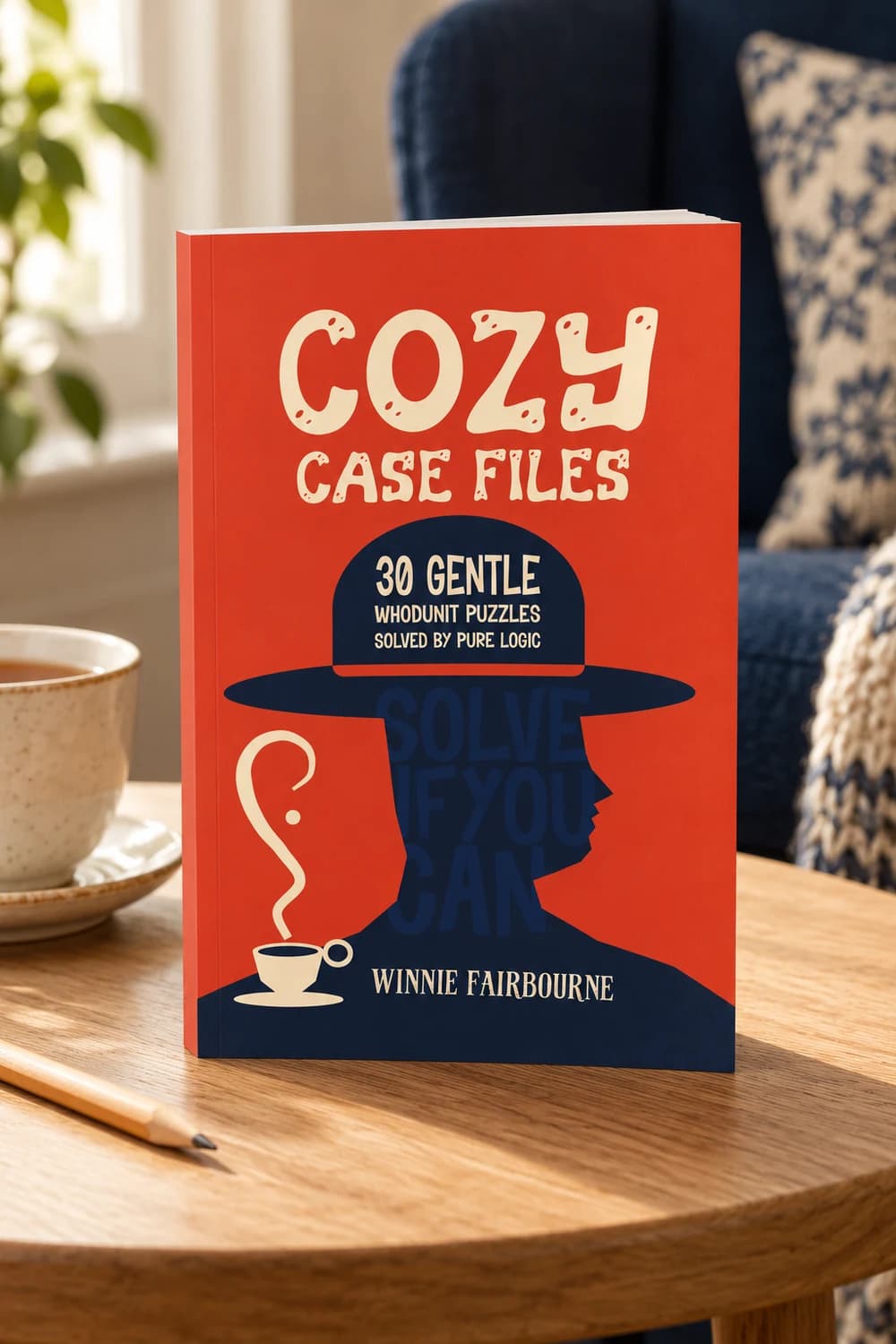
Cozy Case Files: 30 Gentle Whodunit Puzzles Solved by Pure Logic, by Winnie Fairbourne, is my collection of small mysteries set in places such as a village fair, a tea room, a night train, and a lantern-lit inn.
The book has 30 cases across three levels:
- Apprentice: Eight suspects and five clues, beginning with simple elimination.
- Detective: Clues introduce positions, including left, right, and next to.
- Chief Inspector: Ten suspects, six clues, and an extra question about where an item is hidden.
Hints and explained solutions are at the back. The stories involve missing objects rather than murders or gore. The book offers a longer way to continue the kind of reasoning you tried in the practice case above.
Explore Cozy Case Files and choose your Amazon country
Choose USA, UK, Canada, Germany, Italy, or Japan on the book page. Global opens Amazon.com; it does not guarantee delivery to every country. On Amazon, check the available edition, delivery destination, and language before ordering.
A Christmas gift idea for the mystery lover in your family
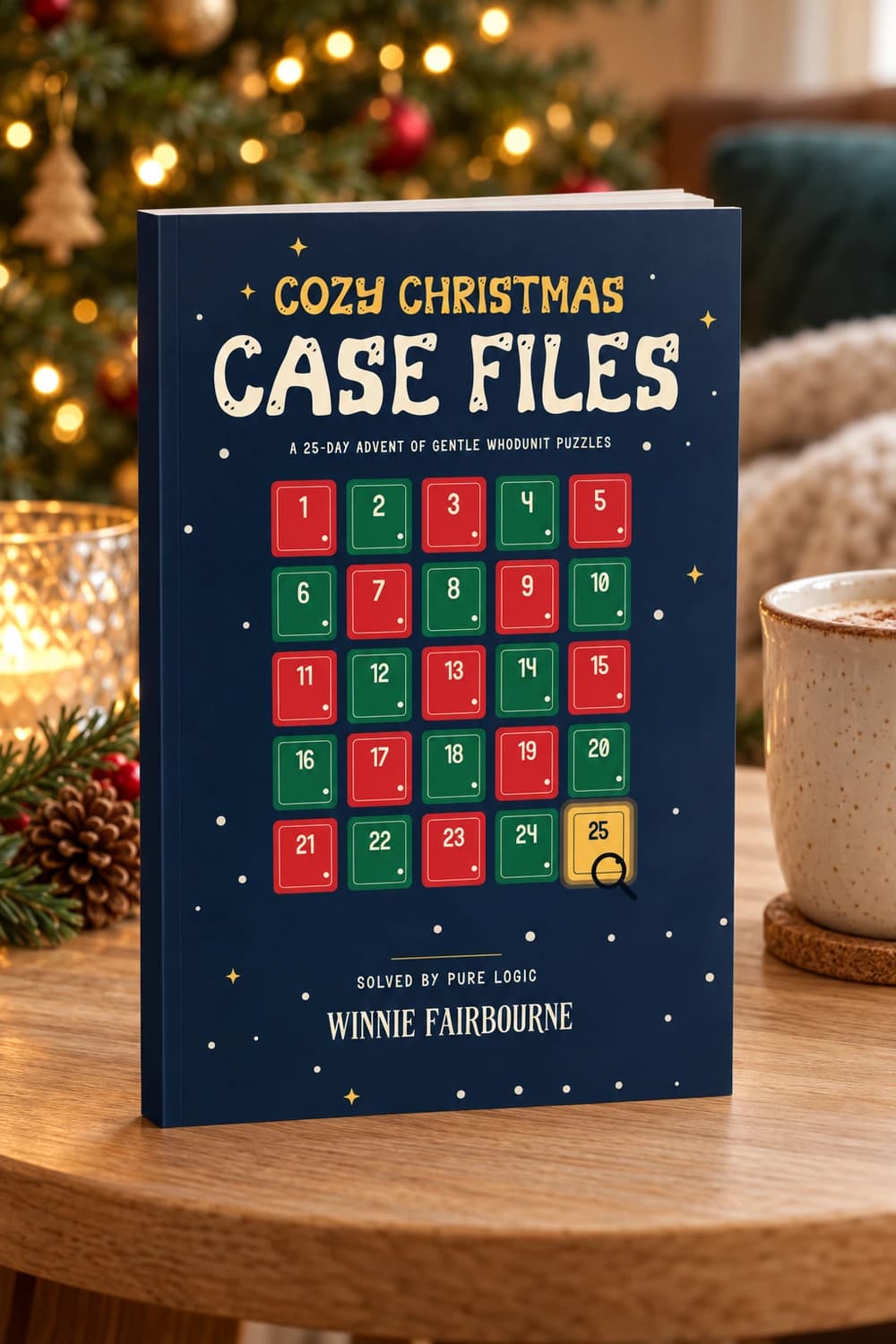
If someone at your table enjoys following clues, a gentle puzzle book is one Christmas gift idea to consider. I also wrote Cozy Christmas Case Files under the pen name Winnie Fairbourne: 25 festive whodunits arranged from December 1 through Christmas Day.
Give it before December for the daily countdown, or wrap it for Christmas and let the recipient enjoy the seasonal cases afterward. An adult can read aloud for a child who needs support; choose the level for the individual reader.
| Book | Cases | When to choose it |
|---|---|---|
| Cozy Case Files | 30 gentle whodunits | A year-round puzzle activity or gift |
| Cozy Christmas Case Files | 25 festive whodunits | A Christmas gift or December countdown |
These are separate books, not a bundle. The Christmas book is a bound puzzle book; its numbered cover doors are printed artwork, not opening flaps or compartments. Check the available edition and delivery details on your chosen Amazon store.
For gift presentation ideas and a different free practice case, read the Christmas gift guide for mystery lovers.
Make up your own tiny case
Choose a familiar place and one missing object. Give four fictional visitors three details each. Pick the person who moved the object, then write clues that leave only that visitor possible.
Test the puzzle before sharing it. Check each visitor against every clue, and make sure there is exactly one answer. If you remove a clue, does another visitor become possible? That is a useful way to check whether the clue has a job to do.
Use friendly fictional names and ordinary objects. Let someone else solve the case, then ask them to explain how they knew.
A note on expectations
These are activities for enjoyment, conversation, and practicing how to follow clues. This guide makes no claim that a puzzle improves memory, raises intelligence, treats a condition, or prevents cognitive decline. Pick the level and pace that feel enjoyable for the people taking part.
Mentioned in this guide
As an Amazon Associate I earn from qualifying purchases. Price and availability are shown on Amazon and can change.